Color Label Printer Brand Comparison
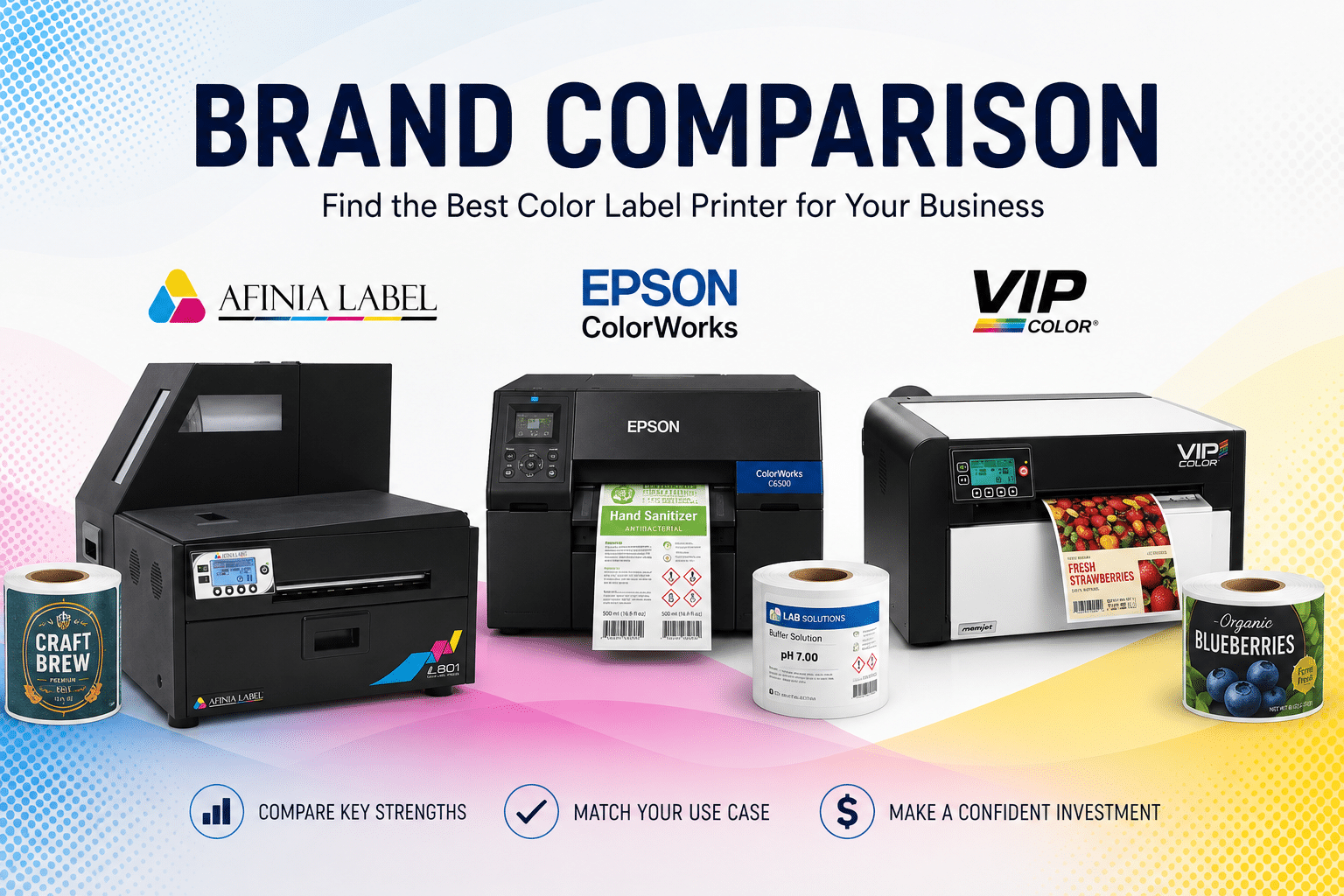
With so many printer models available, comparing every specification can quickly become overwhelming. This guide is intended to serve as a quick reference for understanding the strengths of the major printer brands we offer and the types of applications they are best suited for.
Rather than focusing on technical specifications alone, this section highlights the environments, production volumes, durability requirements, and labeling applications where each brand tends to excel. Where individual printer models within each lineup may vary, understanding each brand’s general strengths can help narrow down your options and identify the solutions that will best fit your needs.
Use the comparisons below as a starting point before exploring specific printer models in greater detail. For more detail on the info below, visit our Color Label Printer Buyer’s Guide.
Brand Comparison
While most color label printers are designed to produce high-quality labels, the technologies behind them can vary significantly. Differences in ink type, print speed, durability, operating costs, and production workflow often have a greater impact on long-term satisfaction than the printer brand itself.
Afinia Label
Afinia has one of the industry’s largest color label printer portfolios, ranging from desktop entry-level printers to high-volume printing and finishing systems. Their products include dye and pigment ink options, Memjet and HP printhead technology, and durable toner-based systems, allowing businesses to choose a solution that aligns closely with their application requirements.
One of Afinia’s product strengths is flexibility. Whether you’re printing short-run product labels, durable industrial labels, metallic labels, clear labels, or high-volume production runs, there is typically an Afinia solution designed for that workflow. Businesses often choose Afinia when they want room to grow without switching manufacturers as production needs evolve.
Epson ColorWorks
Epson ColorWorks printers are built around pigment-based ink technology (with the exception of the CW-D3800) and are widely recognized for being easy to work with and for producing highly durable labels. Their printers are frequently selected for applications where water resistance, chemical resistance, UV resistance, and long-term readability are important considerations.
Epson’s lineup is particularly popular in industries that require compliance labeling, such as chemicals, laboratory products, healthcare, cannabis, and industrial manufacturing. Many customers tell us they appreciate Epson’s straightforward operation and consistent print quality.
VIPColor
VIPColor printers utilize Memjet technology to deliver exceptionally fast print speeds and vibrant color output. These systems are commonly selected by businesses producing product labels that prioritize shelf appeal, branding, and rapid turnaround times.
Because of their speed and print quality, VIPColor printers are popular with food and beverage producers, coffee roasters, nutraceutical manufacturers, breweries, wineries, and specialty consumer brands that frequently change artwork or produce shorter label runs.
Which Technology Is Right for You?
Rather than selecting a manufacturer first, many businesses achieve better results by identifying their primary requirements.
- If durability is the top priority, pigment-based systems are often the best starting point.
- If production speed and vibrant product labels are most important, Memjet-based solutions are worth considering.
- If specialty media, metallic materials, clear labels, or unique application requirements are involved, a broader product portfolio may provide additional options.
The best printer is ultimately the one that matches your label requirements, production volume, and growth plans—not necessarily the one with the most features or lowest purchase price.