
What to Look for in Label Printing Machines 2
What to Look for when researching Label Printing Machines
Business owners are always searching for ways to develop and improve their products and services while creating a product that stands out to customers and makes them want to buy their products over their competitors. For most proprietors, a key element in this department is their brand’s creative packaging and label design. This makes the proper selection of a label printing machine critical.
However, finding the best brand of label printing machine to bring your label printing in-house is not a walk in the park. You will need to consider factors like size, ink tones, printing speed and volume, label durability, water-resistance, cost-efficiency, and compatibility with the item (finish or surface).
To help ensure that you get the right type of printer for your product packaging, check out our quick and informative guide below.
4 Factors You Should Consider Before Buying A Label Printing Machine
Customers enjoy picking items that have crafty packaging, uniquely designed labels, and informative descriptions written on them. One great example of this can be seen through the explosive success of the cannabis industry: By 2026, the cannabis packaging industry could be worth over 290 billion dollars, up from 101.48 billion dollars in 2020, according to Mordor Intelligence. This is a compound annual growth rate (CAGR) of about 22%. With this kind of growth and more suppliers saturating the market, it’s imperative that your label stands out in a crowd.
In addition to catching a consumer’s eye, this also points to how significant product labels are in ensuring that all the required information is well-indicated on the product’s packaging.
1. What is the Ideal Size of Sticker for Your Business?
Most companies already have defined label sizes and may already have those labels printed by a third-party print house. If you are just getting started and are not sure about what label size you should focus on, the first three design components that you will need to determine are:
- Where will the label be placed? They can be put in front or on the back section, top-view capping (mostly used for products with rounded caps), on the bottom (common for glass materials), or through their outer packaging.
- What type of material will it be placed on? The most used materials in the packaging industry include plastic, glass, metal, aluminum, paperboard, foil, carton, and wood.
- What is your label’s branding shape? This will act as your brand’s signature style. The shape (standard or custom) of the label will also carry your business’s official logo.
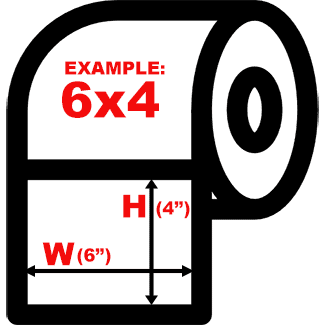
A quarter is about an inch in diameter, while an Oreo is around two inches in size. Round labels usually allow more spacing, design, and logo visibility.
Oval and rectangular labels (business card-sized) are easy to read and can blend well with a variety of package sizes, allowing more creative freedom for your product branding.
It’s also important to keep in mind that your label size can directly impact your cost per label. Not only is the media itself more expensive as your label size grows, but the amount of ink required to fill the area will increase or decrease depending on the label size chosen. Careful thought and planning should go into this decision to be sure you’re getting the optimal cost savings for your design(s).
2. Monochrome or Color Labels?
The most common labels used by low-budget companies or small businesses are black and white. They are cheap, cost-efficient, user-friendly, and easy to purchase. Some label printers also offer monochromatic colors in dark green or yellow.
For high-end brands and commercial-grade products, going full color seems to be the only acceptable option. These types of brands normally have bigger business platforms, budget ranges, audience reach, and competitors.
Color label printers are typically larger and more expensive than monochrome label printers. These top-grade printers are great for private and custom labeling and for creating large volumes of prints per second.
These machines can also provide your company with more branding flexibility as you grow and expand your business and product range.
3. Cost of Ownership
Your total cost of ownership (TCO) depends on many factors such as your monthly label volume, label size, artwork complexity (number of colors and color saturation), the printer model you choose and believe it or not, environmental conditions.
For example, you may pay more upfront for more expensive label printing machines such as the Afinia L901. But since the L901 can utilize a larger 10-inch roll of blank media, your media costs are cut in half by roughly 45% compared to a cheaper model that can only use an 8-inch roll. These and many other factors must be considered when making a color label printer buying decision. Chicago Color Label can help you through this complex decision-making to arrive at the optimal solution.
4. Do You Need Water Resistant Labels?
The most prominent industries and product groups that require water-resistant labels include the food and beverage industry, medical, cosmetics, bath and body, automotive, industrial machinery, and hazardous chemicals. These products need to be kept intact, and their labels need to be non-fading and resistant to weather and water elements.
This type of label is also more cost-efficient and durable than paper-based sticker labels. Unlike paper labels, water-resistant labels will not tear or crack easily, ensuring consumers can always access and read the information on the product label.
For labels that require exposure to harsh environmental conditions like oil, condensation, or high humidity, we highly recommend Afinia L801 PLUS Label Printer. This printer has lightning-fast print speeds that can swiftly generate labels at up to 60 feet per minute. They are ideal for health and beauty products, chemicals and pharmaceuticals, wine and beer, CBD, and refrigerated goods.
Finding the Right Printing Store Online
- Only buy from authentic and official stores – For top-of-the-line services, choose a time-tested color label supplier that has been in the industry for more than 10 years. This ensures you’re working with a company that is experienced with color label printing technologies and knows the right questions to ask and the right advice to give. This will help ensure you purchase the right equipment for your specific requirements and provide a smooth shopping/transaction process and order delivery.
- Request a demo of the item(s) you’re interested in – Find a supplier that can demo their equipment either online or by visiting their local showroom. This gives you an opportunity to “touch and feel” the hardware first hand (or virtually) instead of relying on only images in an online store.
- Check if they have a customer hotline – This means they prioritize their customers and potential shoppers. Having a dedicated contact line or email support can also help their buyers with product-related queries and simple navigation tutorials on time.
- Additional services you can benefit from – Check their website if they offer added perks like on-site repair, extended warranty, and product returns and exchanges. These will be highly beneficial for your business and can also lower total repair, production, and maintenance costs.
I want to print stickers for my shoes products. Which one sticker printing machine is best for this job?
Hi Eric,
If you are placing the labels on the boxes themselves, there is probably little concern over moisture and water exposure so a dye based printer such as the L502 (for lower volumes less than 2500 per month) or the L801 for larger label runs would be perfect.